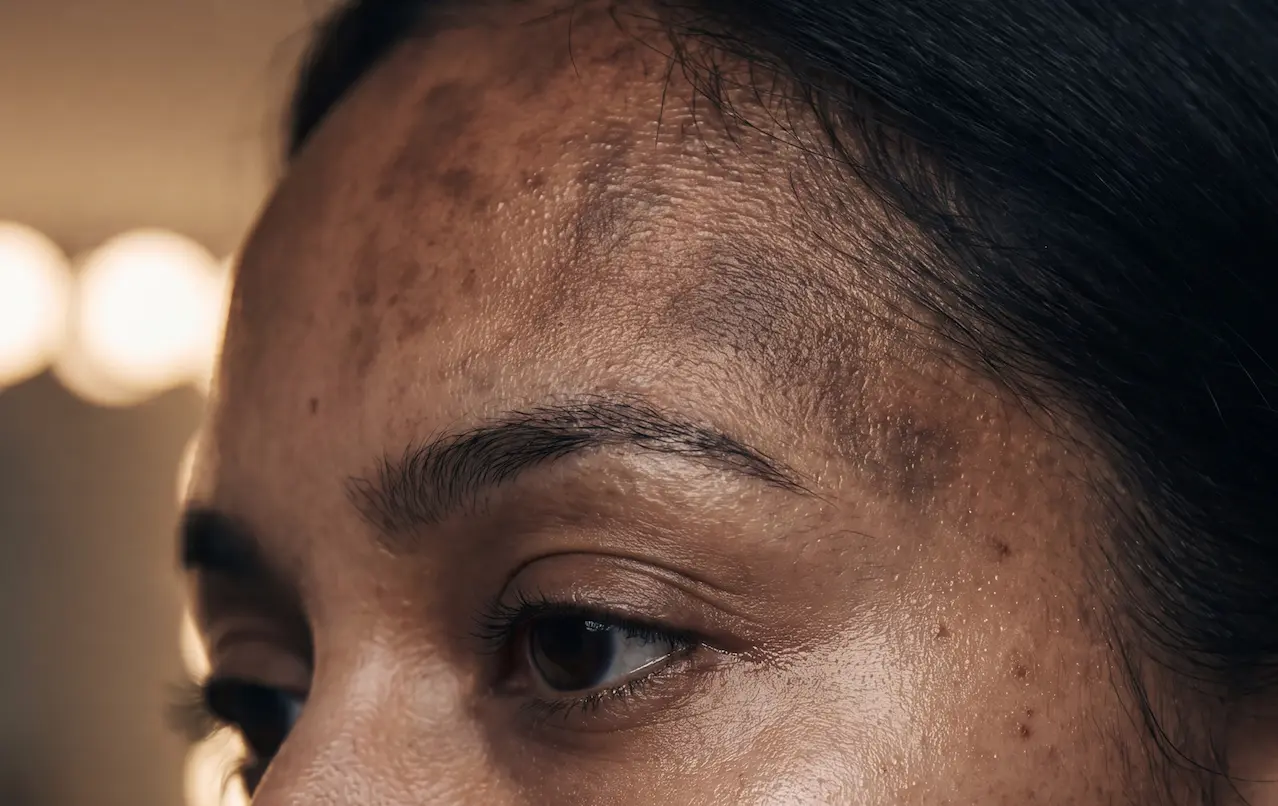
You faded the spot. You celebrated. Then weeks later, it was back.
If that sentence made your stomach drop, you are exactly who we wrote this for. Dark spots are the most common skin concern we see, and they are also the most misunderstood. People throw vitamin C at them for six months and wonder why their face still looks patchy and dark. People book a single laser session expecting a clean slate. People watch a patch fade, stop everything, and feel betrayed when it creeps back darker than before.
Here is the truth nobody tells you upfront. A dark spot is not a stain you scrub off. It is a signal that something deeper is happening in your skin, and the spot you see today was actually made weeks, months or even years ago. We have studied this concern across hundreds of pigmented faces in Vancouver, layering treatments, tracking what holds and what rebounds. This is the quick summary of everything we learned. Buckle up, because some of it is going to surprise you.
What A Dark Spot Actually Is
Let's start with the thing that changes everything.
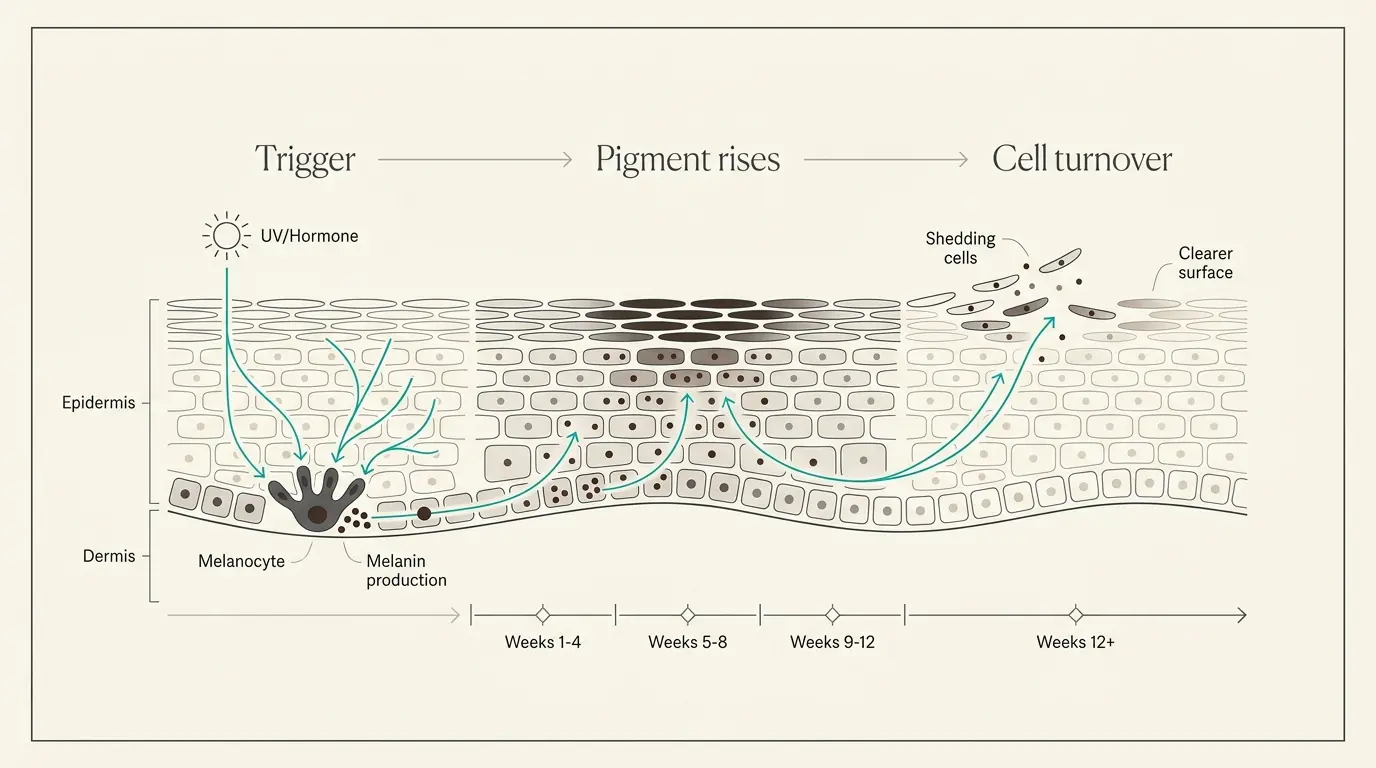
Your skin has pigment factories called melanocytes. When they get a signal, sun, heat, hormones, a popped pimple, they pump out melanin. That melanin travels up through your skin and settles near the surface as a brown or dark mark. Simple so far.
But here is the kicker. Visible dark marks are due to pigment deposition from weeks, months or even years earlier. The spot you are staring at in the mirror is old news. The factory that made it has often gone quiet by the time you notice the result.
This single fact explains almost every frustration on your search history. Why your spots seem to appear out of nowhere. Why they fade slowly. And why, when you treat only the surface, they come right back.
Pigment also sits at different depths. Some marks live in the upper layer where they are easy to reach. Others, like true melasma, plant themselves deeper in the dermis where surface products cannot touch them. Two spots can look identical on top and behave completely differently underneath. That is why a one-size product almost never works, and why a real plan starts with figuring out what kind of pigment you are actually dealing with.
If your discolouration sits alongside redness or flushing, the picture gets more layered still, and calming that reactivity and visible redness often has to happen before brightening will hold.
Why Your Vitamin C Stopped Working
Now to the question we get more than any other. Why is my skin still dull after months of vitamin C?
Vitamin C is genuinely good at its job. It works as a melanogenesis inhibitor by inhibiting tyrosinase and reducing melanin and melanin intermediates. Translation: it tells your pigment factories to slow down, and it mops up the free radical damage from sun and pollution that triggers them in the first place. That is real science, backed by a meta-analysis of dozens of controlled studies.
So why isn't it working for you? Three reasons, and you have probably hit all three.
First, stability. Vitamin C, especially in the form of L-ascorbic acid, is notoriously unstable. Exposure to light and air affects its effectiveness and it becomes ineffective. That bright orange tint in your old bottle? That is oxidized vitamin C, and it does nothing.
Second, concentration. For surprising results, concentrations between 10% and 20% are usually recommended. Many drugstore serums sit far below that.
Third, and this is the big one, vitamin C is a brightener, not an eraser. It moderates pigment production. It does not break up pigment that is already deposited and parked in your skin. Asking it to clear deep, established spots on its own is like asking a smoke detector to put out a fire.
This is exactly where layering matters. A well-built vitamin C and brightening serum does the prevention work beautifully when it is fresh, formulated right, and paired with something that actually lifts existing pigment. Alone, it stalls. In a protocol, it shines.
The other quiet culprit behind dullness has nothing to do with pigment at all. Dehydrated, rough skin scatters light and reads as grey and tired. Sometimes the fix is not more acid but more water in the skin, the kind of plumping you get from layered hydrating actives and a barrier that is not constantly stripped. Glow is half pigment, half light reflection. Most people only treat the first half.
Does Hyperpigmentation Get Worse Before It Gets Better?
Short answer: sometimes, and it is usually a good sign.
Here is what happens. Treatments that work by lifting pigment, certain lasers and peels, push the melanin up toward the surface so your skin can shed it. Sometimes, right after a laser treatment, your hyperpigmentation can become darker. Then, the pigment works its way to the surface of the skin and will shed or peel off.
So that brief darkening you panic about? Often it is the spot on its way out. Some treatments may cause temporary darkening in the first 2 to 4 weeks as pigment rises to the surface before shedding.
But, and this matters, there is a wrong kind of worse too. Aggressive, poorly chosen treatment on reactive skin can trigger fresh pigment instead of clearing it. The difference between good worse and bad worse comes down to who is holding the device and whether your skin was prepped properly. This is not a corner to cut. The whole reason gentle, well-controlled treatment exists is to get the clearing without the backfire.

The Mystery Of The Returning Spot
This is the heartbreak question. My dark spots came back after fading. Why?
Take a breath, because the answer is not that you failed. It is biology, and once you understand it you can finally outsmart it.
Most returning pigment is one of two stories.
Story one is melasma. If your spots are symmetrical patches on your cheeks, forehead, or upper lip, and they flare with sun or hormones, this is likely you. And melasma plays by different rules. Melasma is a chronic, relapsing hyperpigmentation disorder driven by complex interactions among genetic predisposition, hormonal fluctuations, UV exposure, oxidative stress, inflammation, and photoaging.
Read that again. Chronic. Relapsing. The skin often remains sensitive to triggers such as ultraviolet light and hormonal fluctuations. This sensitivity explains why melasma can return even after improvement. You can fade the visible patch beautifully, but you cannot delete the underlying tendency. The factories are still there, still twitchy, waiting for a trigger.
Story two is simpler and almost universal. You stopped. The mark faded, you felt great, you abandoned your sunscreen and your routine, and your skin quietly went back to doing what it does. The mark is gone, you celebrate, you stop your routine, and weeks later the mark is back.
So the spot did not really come back. The conditions that made it never left.
Here is the part that gives you power. Pigment is managed, not cured, and management works. When you approach melasma as a condition that may need ongoing management rather than a one-off solution, professional treatments become a valuable tool in maintaining clear, even skin. The people with the clearest skin are not the ones with the best single treatment. They are the ones who never fully stopped.
That is the whole philosophy behind a discolouration program that adjusts as your skin shifts, rather than a one-and-done appointment you hope will hold forever.
How Often Should You Actually Treat?
Let's get practical, because this is where people either waste money or quit too early.
Your skin renews on a cycle. Natural skin cell turnover occurs approximately every 28 days, but this process slows with age and varies by individual. That cycle is the clock everything runs on. You cannot rush pigment out faster than your skin sheds it, which is exactly why "one treatment" is a myth.
Here is the realistic rhythm for professional pigment work:
Space sessions about 4 weeks apart. Most pigment-focused treatments are scheduled in a series, commonly spaced four to six weeks apart so each one works with your turnover cycle instead of against it.
Expect early wins around two weeks. You will often notice brightness and smoother texture within the first fortnight, before the spots themselves fully shift.
Plan for a course, not a cameo. People undergoing a course of multiple professional skin treatments can expect subtle pigment reduction after 12 weeks or the first 2 to 3 treatments, and cumulative improvement after 3 to 6 treatments.
Then switch to maintenance. Once you are clear, you shift to milder sessions and a steady home routine to hold the result.
And the warning label, in plain words: relapse is high if there is no maintenance with topical skin treatments and strict sun protection. Skip the upkeep and you are back to square one.
Gentle resurfacing between deeper sessions keeps momentum going. A light enzyme treatment or a manual dermaplaning pass clears the dulling layer of dead cells so your actives sink in and your glow comes back faster.
HydraFacial Versus Chemical Peel For Dark Spots
The two most-Googled head-to-head in Vancouver. Which one wins for discolouration?
Honestly, this is the wrong question, and we will explain why in a second. But you deserve a real comparison first.
A HydraFacial cleanses, gently exfoliates, and floods the skin with brightening and hydrating serums in one comfortable session. Zero downtime. You walk out glowing. For dullness, congestion, and overall radiance, it is fantastic. As a standalone dark-spot eraser, it is more of a brightening boost and a maintenance tool than a heavy hitter.
A chemical peel goes deeper into the pigment problem. Peels work by dissolving the bonds between skin cells so the pigmented top layers slough off and fresher skin surfaces. For sun spots and surface pigment, this is where real fading happens. The trade-off is a few days of flaking and a bit more aftercare.
So for stubborn dark spots and sun spots, a peel pulls more weight. For glow, hydration, and gentle upkeep between heavier treatments, HydraFacial is the gem.
But here is the thing we promised you. The clinics getting the best pigment results are not choosing one. They are sequencing both, plus targeted brightening and barrier support, on a schedule mapped to your skin. A standalone treatment treats a symptom. A protocol treats the pattern.
Mandelic Versus Lactic: The Peel Question
If you have gone down the rabbit hole, you have hit this exact comparison. Mandelic peel or lactic peel for dark spots?
Both are alpha hydroxy acids. Both brighten. But they behave very differently, and the difference is the whole point.
Mandelic acid is the gentle giant for pigment. Its large molecular structure slows its absorption into the skin, so it doesn't cause irritation that can trigger an inflammatory response. That slow, even penetration is a feature, not a flaw. For treating discolouration, no acid can match mandelic's brightening ability. It is especially smart for deeper skin tones, where harsh exfoliation can spark the very pigment you are trying to clear.
Lactic acid is the hydrating brightener. It exfoliates, it brightens, and it pulls moisture into the skin while it works, which is why dull, dry, rough complexions love it.
What does the research say when they go head-to-head? In a 2025 study comparing the two on stubborn under-eye pigment, both 30% mandelic and lactic acid peels effectively treated periorbital melanosis, with lactic acid showing better outcomes and patient satisfaction, and lactic acid may be better for sensitive skin due to milder side effects.
So which is right for you? It depends on your skin type, your pigment depth, and your tolerance, which is exactly the kind of call that should be made in person, not from a search bar. This is also why thoughtful clinics rarely hand you a single acid. They blend and rotate based on how your skin actually responds, session by session.
Laser Versus Topicals: Same Goal, Different Tools
You asked for the similarities and differences, so here they are, clean.
The similarity is the target. Both lasers and topical ingredients are chasing the same enemy: excess melanin. Both can fade spots, both need consistency, and both fail without sun protection backing them up.
The difference is method and depth.
Topical brighteners work slowly and from the surface, mostly by telling your pigment factories to ease off and by nudging dull cells to turn over. They are your daily defence and your maintenance backbone. Ingredients like a stable brightening complex and supportive antioxidants do steady, quiet work over months. The catch, as we covered, is that they manage production but struggle to clear pigment already buried in your skin.
Lasers reach what creams cannot. A laser delivers targeted energy that breaks up existing pigment so your body can carry it away, and it reaches depths topicals simply cannot. The right laser also calms the underlying inflammation and the tiny blood vessels that feed conditions like melasma, which is something no serum can do.
Here is where the tool matters enormously. Older, harsher lasers carried real risk for medium and deep skin tones, because heat damage to the surface could trigger more pigment instead of less. The laser we use, the Aerolase Neo Elite, was built around that exact problem. It targets melanin in the dermis by safely bypassing epidermal melanin, enabling the laser energy to penetrate to greater depths, increasing efficacy and safety for all Fitzpatrick skin types. Its ultra-short pulse adds a greater margin of safety, reducing the risks of burns, hyper and hypopigmentation.
The numbers are real too. Clinical studies have shown up to 50% improvement in melasma within as little as 3 weeks, with continued improvement over a full treatment series. And in melasma specifically, a single session has been measured to produce a 52% reduction in vessel diameter and a 22% reduction in vessel density, hitting the vascular trigger that most treatments ignore entirely.
So the honest answer is not laser versus topicals. It is laser plus topicals. The device clears what is there. The routine stops the next wave. That combination is the difference between a result that lasts and a spot that comes back in eight weeks.
Meet Priya, And Her Two Years Of Frustration
Let us make this real, because numbers only land when you see them on a face.
A client we will call Priya came in last spring. Thirty-four, sharp, exhausted by her own reflection. For two years she had been fighting brown patches across her cheeks. She had a drawer, an actual drawer, of half-used vitamin C serums. She had tried a single laser session somewhere that left her patches briefly lighter and then noticeably darker. She was convinced her skin was simply broken.
It was not. Her skin was doing precisely what melasma-prone skin does. Her serums had oxidized. Her one laser session was too aggressive and unsupported. And she had stopped wearing sunscreen indoors because, in her words, "I'm at a desk all day."
We did not hand her a miracle. We built her a program. Gentle pigment-safe peels rotated with calibrated laser sessions on the Neo Elite, every few weeks, mapped to her turnover cycle. A fresh, properly dosed brightening serum. Barrier repair so her skin stopped overreacting. And a non-negotiable sunscreen habit, including the days she never left the house.
At the twelve week mark she sent us a photo from her car in daylight, no filter, the light she used to avoid. The patches were not gone completely. Melasma rarely vanishes. But they were faint, even, and she finally understood they were managed, not magic. The drawer went in the bin. She still comes in for maintenance, and her skin has held for months.
That is the whole point. Not a cure. A system she could trust.
The Best Value Move You Can Make
Quick gut check before we wrap. If you are comparing clinics in Vancouver for pigmentation, here is what actually separates the good from the forgettable:
They diagnose before they treat. Surface pigment and dermal pigment need different tools. If nobody assessed which you have, walk.
They combine modalities. One device for everyone is a red flag. Your skin is layered, your treatment should be too.
They use technology that is safe for your skin tone. This is non-negotiable for medium and deep complexions.
They build in maintenance. Anyone promising a permanent one-session fix for pigment is selling, not treating.
They adjust as you go. Skin evolves. A static plan is a stalled plan.
This is exactly the standard we hold ourselves to, and if you want a plan built around your skin instead of a generic package, the easiest first step is a proper consultation where someone actually looks at what your pigment is doing before recommending anything.
Let's Bring It Home
So, the spots that keep coming back. Here is everything in one breath.
A dark spot is old pigment made weeks ago, which is why it fades slowly and rebounds quietly. Vitamin C brightens but does not erase, and it dies in the bottle if it is old or weak. Pigment getting darker before it clears is often the spot leaving, as long as the treatment was gentle and well chosen. Melasma is chronic and relapsing, so it is managed, not cured, and the people with the clearest skin simply never fully stop. Peels outwork facials on stubborn spots, mandelic is gentler while lactic is more hydrating, and the real winner is never one tool. It is laser to clear, topicals to maintain, sunscreen to protect, all on a rhythm that matches how your skin actually renews.
Your spots were never a sign of failure. They were a sign you were treating the symptom instead of the pattern. Change that, and your skin changes with it.
We genuinely hope this saved you months of trial and error. We spent days researching, fact-checking, and condensing the most useful insights on pigmentation we could find, so you would not have to. If it helped you understand your own skin even a little better, sharing it with someone who is still fighting their reflection would mean the world.