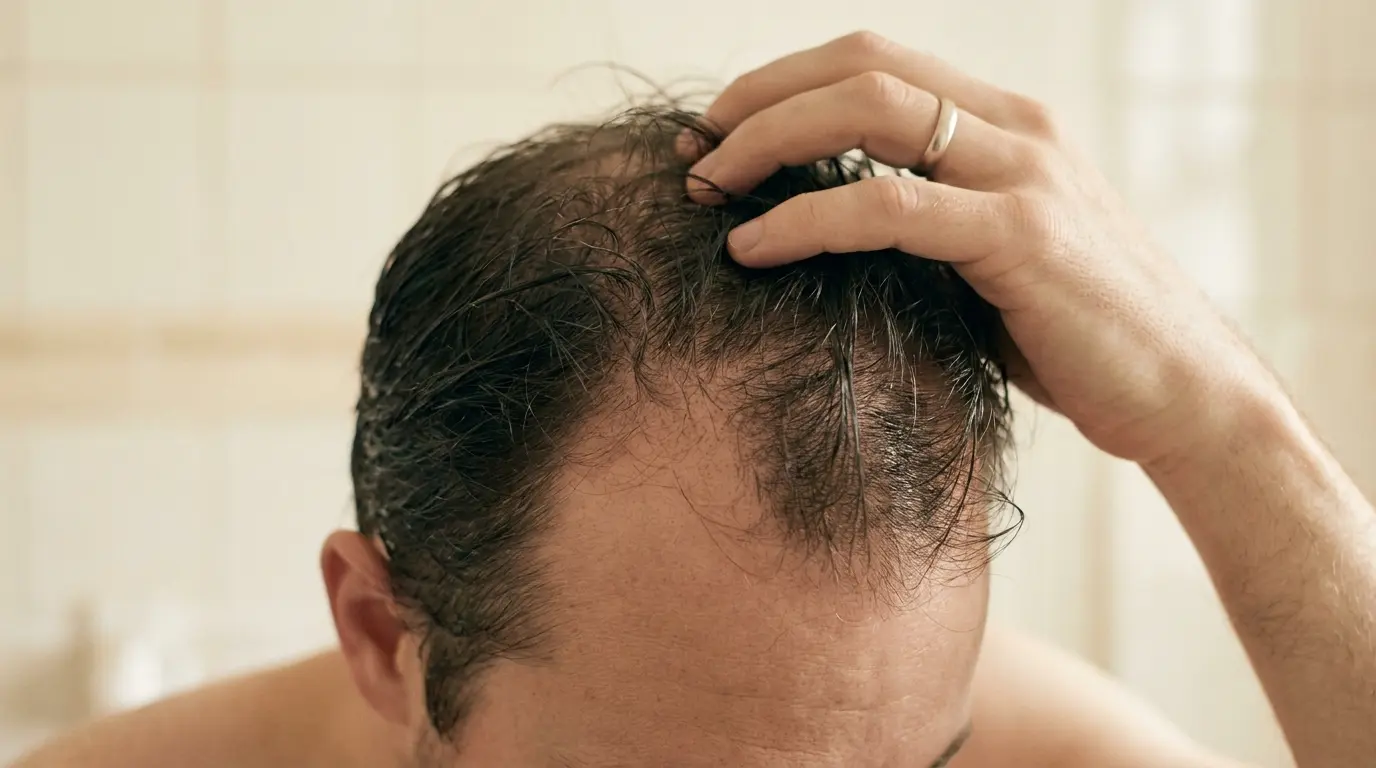
We have all stood under harsh bathroom light, tilted our head, and watched the scalp peek through where it never used to. The stomach drops. Then comes the late-night scrolling, where every clinic in the city promises the same miracle. But here is the part almost nobody says out loud. The most hyped "regenerative" hair treatment in Vancouver may be quietly limited by something you cannot change on your own: the age of your own blood. We read through eleven clinical studies and a stack of peer-reviewed trials to write this. Give us six minutes. Your hairline has waited long enough.
So here is the map. We will break down what is really thinning your hair, why the popular PRP route can underdeliver, what exosomes and peptides actually do, and how a proper layered program gets built. No fear-mongering. Just the science, in plain language, with a real way forward.
What Is Actually Thinning Your Hair
First, a reset. Not all hair loss is the same loss. Two people can stare at the same widening part and have completely different problems underneath.
One type is genetic and slow. The other is sudden and reactive. Treating them the same way is how people waste a year and a small fortune.
Picture two women. One notices her ponytail has been shrinking for five years, a little thinner each birthday. The other watched her hair come out in fistfuls three months after a brutal flu. Same fear in the mirror. Two very different stories underneath. And here is the crazy part: the second woman will often recover most of it, if the right things happen at the right time.
By around age 60, close to 45 percent of men and 35 percent of women show some degree of pattern hair loss. It is that common. So if this is you, you are in very good company, and you are nowhere near out of options.
Why Women Thin So Suddenly
When hair sheds fast and all over, the usual suspect is a condition called telogen effluvium. In plain terms, a shock pushes a big batch of follicles into the resting phase at once, and weeks later they all let go together. People often shed 300 to 500 hairs a day during a flare, which feels apocalyptic in the shower drain.
The triggers are sneaky, because they tend to happen months before the shedding starts. According to the Cleveland Clinic, the most common ones include:
A high fever, serious infection, or recent surgery
Childbirth and the hormone crash that follows
Thyroid imbalances, both underactive and overactive
Low iron, vitamin D, zinc, or protein from restrictive dieting
Intense emotional stress or grief
Here is the hopeful part. When the trigger is found and addressed, most people recover within a couple of months. The follicles are not dead, just napping. The job then is to calm the scalp, refuel the follicle, and shorten the recovery window. That is exactly where calming soothers and treating any lingering scalp redness earn their keep, because an inflamed scalp is a scalp that holds grudges.
When It Is in Your Genes
The slow kind is different. Over years, hormones, mostly a testosterone byproduct called DHT, gradually shrink the follicle in a process called miniaturization. The hair grows back finer, then shorter, then eventually not at all. This is the pattern behind most men's hair thinning and a large share of female thinning too.
You cannot rewrite your genetics. But you can wake up sluggish follicles and thicken what is still there, especially if you start before the follicle gives up entirely. That is where regenerative treatments come in. And it is where the first big myth needs busting.
PRP vs Hair Growth Factors

PRP, platelet-rich plasma, is the treatment everyone has heard of. The clinic draws your blood, spins it in a centrifuge, and injects the concentrated platelet layer back into your scalp. The theory is sound. Platelets carry growth factors that can nudge follicles awake.
But here is the kicker. PRP is only ever as good as the blood you walked in with that day.
And blood changes as we age. Research on platelet samples shows donor age is negatively linked to key regenerative growth factors, with studies finding levels of PDGF-BB and IGF-1 drop significantly in older donors. Cells supported by younger donors under 25 consistently outperform those from donors over 45. Plasma from people in their 60s simply does not regenerate the way younger plasma does.
So think it through. The people most motivated to fix their hair are often the people whose plasma has the least raw material left to give. You can spin that blood as hard as you like. Concentrating a small number of useful growth factors does make them more bioavailable, true, but concentration cannot manufacture what is no longer there. You end up with a denser version of a depleted resource. The popular "more concentration equals more results" pitch quietly falls apart, because researchers have shown that raw platelet count is a poor stand-in for actual growth factor quality.
This is the unglamorous reason PRP results swing so wildly from person to person.
Now flip it. Lab-grade hair growth factors are not harvested from your aging bloodstream. They are produced to a standard and delivered at a known, potent dose, the same every single visit. That means your outcome does not hinge on how old your blood happens to be. It is the difference between hoping your pantry has enough flour and walking into a kitchen stocked exactly to recipe. For anyone past their thirties, that distinction is not small. It is often the whole ballgame.
Do Exosomes Regrow Hair or Just Slow the Loss?
This is the question we get most. Are exosomes real regrowth, or just an expensive way to slow the bleed?
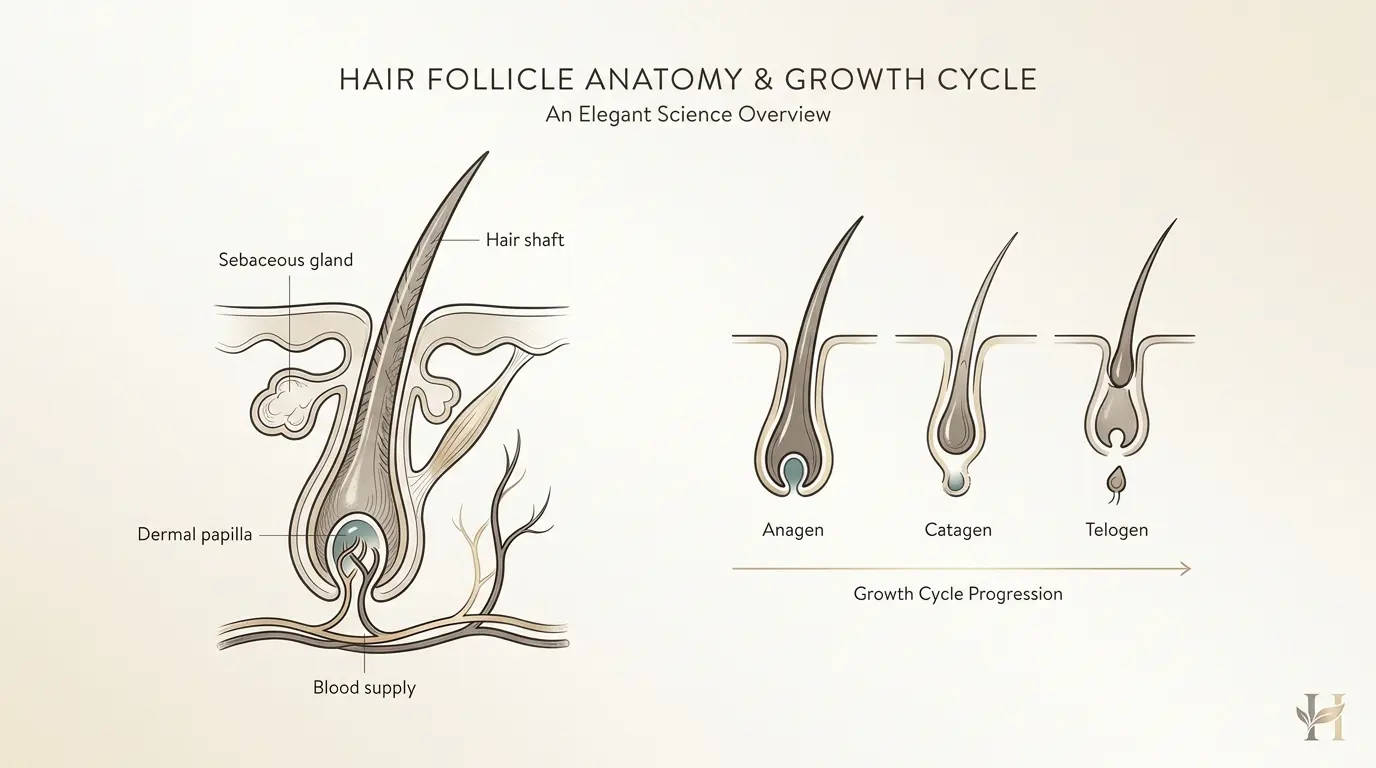
Quick primer. Exosomes are tiny messenger vesicles that carry instructions between cells: proteins, lipids, and genetic signals. In the scalp, they speak directly to the dermal papilla, the control room at the base of each follicle. They encourage new blood vessel growth, dial down inflammation, and coax follicles back into their active growth phase.
Here is where it gets interesting. A 2025 systematic review of clinical studies found that exosome therapy increased hair density by roughly 9.5 to 35 hairs per square centimetre and thickened individual strands across multiple trials and exosome sources. One prospective study tracked density climbing from about 96 to 163 hairs per square centimetre. That is not just slowing a loss. That is measurable new coverage.
And here is the crazy thing nobody expects. In some observational work, exosome therapy even prompted gray hairs to start returning to their natural colour, often within a few sessions. We do not promise that, but it tells you how deeply these signals reach into the follicle.
The honest caveat: the field is young, and results vary by person and protocol. So no clinic should promise miracles. But the trend in the data is genuinely encouraging, and the safety record so far has been clean. This is why exosomes and PDRN have become the centrepiece of modern non-surgical hair work in Vancouver and beyond.
What Peptides Add
Exosomes deliver the message. Peptides keep the conversation going between visits.
Specific copper peptides, like the well-studied GHK-Cu, have been shown to extend the follicle's growth phase, enlarge shrinking follicles, support those crucial dermal papilla cells, and improve blood flow to the scalp. Some studies have found copper peptides hold their own against standard topical regrowth agents, through a gentler and more targeted route. Stacked on top of exosomes, they help the early gains actually stick instead of fading once the appointment ends.
So what is the real difference between exosomes and PRP? PRP recycles your own limited supply. Exosomes and peptides bring in fresh, standardized signalling from the outside. One is bound by your biology. The other is not.
Non-Surgical Hair Restoration, The Vancouver Aesthetician Way

Here is what most places get wrong. They sell you one tool and call it a treatment. We do not believe in single-shot fixes, because follicles do not respond to single signals.
At The Vancouver Aesthetician, a hair session is layered on purpose. Think of it less like one lonely injection and more like a full meal built for the scalp. A typical visit runs like this:
A deep enzymatic scalp cleanse to clear the buildup and oil that smother follicles, paired with gentle lymphatic work to wake up circulation.
Precise microneedling to open micro-channels, which is exactly how we reach stubborn thinning on the crown and temples, where topical serums normally cannot penetrate.
A custom cocktail of exosomes, peptides, and growth factors driven straight into those open channels while the door is still open.
A calming LED light finish, sometimes with a gentle laser pass, to settle the scalp and support the follicle.
Progress tracking, so every future session is adjusted to what your scalp is actually doing, not a generic template printed for everyone.
Let me make this real. Maya, a 38-year-old who runs marketing for a tech firm, came in deflated. She had done a round of PRP elsewhere, seen a flicker of improvement, then watched it stall out. Her part was widening again. We mapped her scalp, found early miniaturization plus a stubbornly inflamed scalp, and built a layered program around exosomes and growth factors instead of her own thinned-out plasma. By month three, baby hairs were filling in along her temples. By month five, she stopped angling her phone camera to hide her part. Same woman, completely different posture.
That is the whole point of layering. Clean the soil, open the channel, deliver the signal, calm the scalp, then measure and adjust. Skin and scalp keep evolving, so the plan should evolve right along with them. Between visits, a custom regimen built from medical-grade products keeps feeding the follicle, so the work does not stop the moment you leave the chair.
Who Is a Candidate?
Good news first. Most people exploring non-surgical hair restoration are strong candidates, because this approach works best earlier rather than later. You are likely a good fit if:
You have noticed thinning, a widening part, or a softer hairline over the last few years
Your shedding spiked after stress, illness, or childbirth and never fully bounced back
You can still see fine "peach fuzz" hairs in the thinning zones, which means living follicles
You tried serums or PRP and walked away underwhelmed
You want to protect the hair you have before it disappears
The honest exception: if a follicle is fully gone and the skin has scarred over, no serum on earth can resurrect it. That is precisely why timing matters so much. Sooner is kinder to your hairline than later.
How many sessions will you need? For most people, a starting series of three to six treatments spaced about four weeks apart is the sweet spot. First visible changes tend to surface around the three-month mark, simply because that is how slow and steady the hair cycle is, with continued gains over six to twelve months and light maintenance after that. Anyone promising overnight regrowth is selling something other than biology.
If you want to know exactly where your scalp stands, the simplest next step is a proper mapping session and a personalized hair program built around what we actually find.
The Bottom Line
Let us tie it together. Sudden shedding is usually reversible once the trigger is handled. Genetic thinning is slow but very treatable when you catch it early. PRP can help, yet it is capped by the age and quality of your own blood, which is exactly why lab-grade growth factors, exosomes, and peptides have become the smarter backbone of modern hair restoration. And a layered protocol beats any single tool, every single time.
The mirror does not have to keep winning. Hair is surprisingly patient when you give it the right signals, in the right order, consistently.
We hope this saved you months of guesswork. We spent days reading the research, fact-checking every claim, and squeezing it all into a six-minute read so you would not have to. If it helped, sharing it with someone quietly worrying about their hairline would mean the world to us. That is how the right people find the right answers.