
We have all seen it. The flushed post-sauna selfie, captioned with something about "detoxing."
But what if that glow is mostly blood flow, and some of your favourite protocols are quietly working against your skin?
I read dermatology papers for a living. For this piece, I went back to the primary research behind six popular habits: sauna, hot yoga, cold plunges, red light, sleep and training. Some held up beautifully. A couple fell apart. One genuinely surprised me.
Here's the honest scorecard, plus a protocol you can run tomorrow morning.
What Heat Actually Does to Your Skin
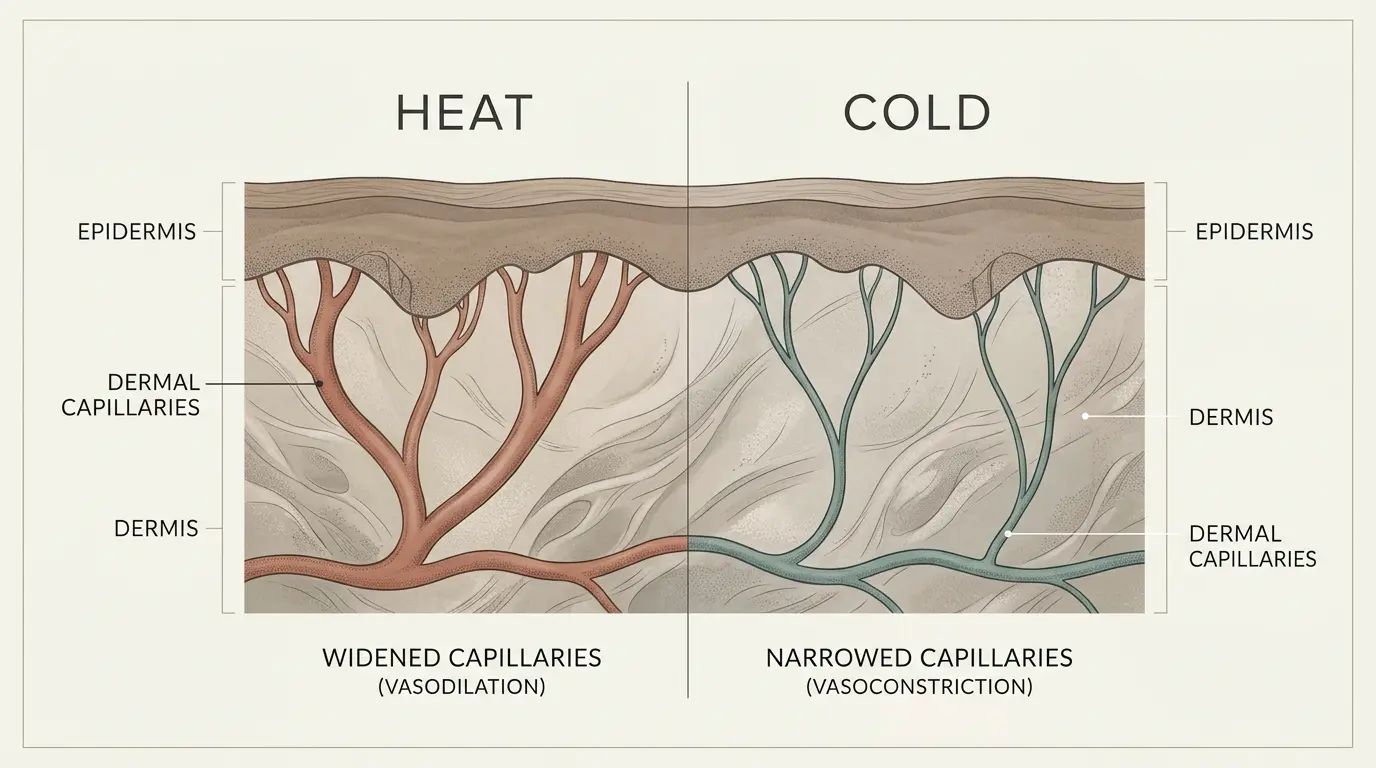
Step into an 80°C sauna and your body does one thing above all else. It dumps heat. Vessels near the surface dilate, blood rushes outward, and your cheeks turn pink.
That is the glow. It's real. It also fades within the hour.
So is anything lasting happening underneath? A little, yes. In a controlled German study of 41 volunteers, regular sauna users showed a more stable skin barrier, better water-holding capacity and faster recovery of skin pH after two 15-minute rounds at 80°C. Their foreheads also produced less oil at baseline.
Encouraging. But that's 41 people in one lab. Treat it as a pleasant side effect, not a treatment plan.
The detox claim does not survive the data
Here's where the marketing falls apart. Sweat is about 99% water, plus salt and traces of potassium, lactate and urea. Detoxification is your liver's and kidneys' job. Studies measuring metals in sweat find only trace amounts, far less than you clear in urine.
You are not sweating out last weekend. You are sweating out water.
When heat works against you
Now the part most wellness feeds skip. Heat is a well-known trigger for two very common skin conditions.
Rosacea and persistent flushing. Repeated vasodilation can make redness and visible capillaries more stubborn over time.
Melasma. This one shocks people. Heat, not only UV, can darken melasma. You can wear SPF 50 every day and still feed those brown patches from inside a 40°C yoga studio.
Which brings me to Sofia.
Sofia's spring problem
Sofia is 38, a product lead at a Mount Pleasant tech company, and the most disciplined client I have ever met. She tracks HRV. She eats like a nutritionist. She does hot yoga four mornings a week and infrared sauna on Sundays. She reapplies mineral SPF at her desk at 1 p.m. without fail.
And every spring, the melasma on her upper lip and cheekbones came back darker.
She showed me a spreadsheet. (Of course she did.) Sun exposure: flat. Products: unchanged. Hormones: checked. The one variable that never made the sheet was heat, because heat felt like the healthy part.
We didn't take yoga away. We moved two classes to a room kept around 30°C, added a cool compress straight after class, and rebuilt her routine around brighteners like tranexamic acid and niacinamide. In clinic, we layered gentle, pigment-safe modalities session by session and tracked her with standardized photos.
By June she sent me two photos side by side. Same light, same angle. The shadow above her lip had faded so much she had stopped wearing concealer to the office. Her message was two words: "Variable found."
Cold Plunges, Contrast Therapy and Your Capillaries
Cold has a fan club for good reason. It's bracing, it lifts your mood, and on your face it constricts vessels and shrinks puffiness for a while.
But here's the kicker. Hot-to-cold cycling forces tiny facial vessels to clamp and flare, again and again. For most people, no problem. For anyone prone to flushing or rosacea, that rapid swing can make redness worse. The research on contrast therapy and facial skin is thin, so I won't pretend it's settled. I'll tell you what we see in clinic and how to hedge.

Contrast therapy, skin-smart edition
Plunge your body, not necessarily your face. Keep your head above water if you flush easily.
Skip the ice-water face splash straight out of the sauna. Give your skin a minute or two to cool first.
Finish lukewarm, not hot. A scalding final shower undoes the calm.
Moisturize within three minutes. Humectant on damp skin, then seal with a barrier cream.
Pause during an active flare. One week off cold beats a month of redness.
Want the depuffing without the vascular whiplash? Lymphatic drainage moves fluid out of the face with zero temperature shock, which is why so many of our clients book it the day before an event.
Heat Changes How Your Skincare Behaves
Warm, damp skin is more permeable. That's chemistry. It's also why "putting on your retinoid before the sauna to drive it in" is a genuinely bad idea.
More penetration of a strong active means more irritation, not more results. The same goes for glycolic acid, high-strength vitamin C and benzoyl peroxide.
The fix is timing. Strong actives belong on non-heat nights, or at least an hour after your skin has fully cooled. Straight after heat, reach for the gentle stuff: humectant hydrators on damp skin, which pull water in while your skin is most receptive, and signalling peptides, which support firmness without the sting.
The Most Underrated Protocol: Sleep (and Training)
If I could give every biohacker one skin intervention, it would not be a device. It would be sleep.
In a study of 60 women at University Hospitals Cleveland, good sleepers (7 to 9 hours) showed 30% greater skin barrier recovery 72 hours after a controlled barrier injury than poor sleepers (5 hours or less). They also cleared UV redness faster and scored lower on signs of intrinsic ageing. A skincare company funded it, so read it with one eyebrow raised. Still, it was peer reviewed, and the direction matches everything else we know about overnight repair.
Training holds up too. Researchers at McMaster University found that habitually active adults showed fewer age-related changes in their skin than sedentary peers, and traced part of the effect to IL-15, a signal released by working muscle. Put simply, your muscles talk to your skin. That's a lovely sentence to read at 6 a.m. while lacing up.

Red light: real, but dose matters
LED is one of the few wellness tools with genuine dermatology behind it. Red and near-infrared wavelengths support collagen signalling and calm inflammation. Blue light targets acne-causing bacteria. The catch is dose. Many at-home masks deliver a fraction of a clinical panel's energy, so scale your expectations accordingly. In clinic, we use LED therapy as one layer of a session, never the whole show.
Your Skin Protocol, Rebuilt
Here's how I'd structure a week for someone who loves heat, cold and data:
Morning: antioxidant serum, then broad-spectrum SPF 30 or higher. Antioxidants blunt the oxidative stress from sun and from heat itself.
Sauna days: 15 to 20 minutes, a cool damp towel over your face, no actives beforehand.
Post-heat: lukewarm rinse, hydrator on damp skin, ceramide barrier cream.
Evening actives: retinoid or exfoliating acid only on non-heat nights.
Sleep: guard 7 to 9 hours like it's your most expensive serum. Honestly, it is.
Monthly, in clinic: a layered session tuned to your data. For clients chasing long-term anti-ageing results, that often means regenerative layers like exosomes and PDRN and growth factors, combined with LED and adjusted as we track progress.
Optimize the Inputs, Not the Glow
The scorecard, in one breath. Sauna: mildly good for your barrier, useless for detox. Heat: a hidden trigger for redness and melasma. Cold: great for your mood, careful with your face. Red light: real, and dose-dependent. Sleep and training: the quiet heavyweights.
The best protocols are rarely the most extreme ones. They're the ones that get measured, adjusted and run consistently. That's exactly how we treat skin at TVA: every session layered, every result tracked, the plan rewritten as your skin changes.
If you'd like to bring your data and build that plan together, a consultation is the place to start.
We hope this was worth your time. We spent days in the primary literature, fact-checking every claim so you can skip the noise. If it sharpened your thinking, share it with the friend who brings a thermometer into the sauna. It would mean a lot.